Multidrug-resistant organisms in adult social care: hand hygiene, equipment and dignity
A wheelchair moves from the lounge to a bedroom. A carer supports someone with personal care, then helps with medicines. A walking frame is shared between people. These ordinary parts of a shift are also the moments when infection prevention and control (IPC) needs to work reliably.
For adult social care teams, managing multidrug-resistant organisms (MDROs) is not about treating a person as a risk or removing them from everyday life. It is about consistent standard IPC: clean hands, clean equipment, a clean environment, accurate communication and proportionate, person-centred decisions.
The direct answer: MDROs can spread through direct contact during care and indirectly through contaminated equipment or surfaces. The practical response is to follow hand hygiene and cleaning processes every time, while protecting the person’s privacy, autonomy, relationships and access to normal activities. Known carriage alone should not automatically lead to exclusion, delayed care or changes to a care plan.
What are multidrug-resistant organisms (MDROs)?
MDROs are germs that do not respond to commonly used treatments, including antibiotics, antivirals, antifungals or antiparasitic medicines. They may be passed on through direct contact with a person during care, or indirectly when hands, surfaces or equipment have become contaminated.
A person can carry an MDRO without feeling unwell. This is called colonisation or carriage. UK Health Security Agency (UKHSA) guidance explains that carriage can last for years and is not harmful in itself. However, infection is more likely in people with wounds, indwelling devices or weakened immunity.
This distinction matters in social care. A record of MDRO carriage is information that helps staff provide safe, tailored care; it should not become a label that limits a person’s life.
Why routine care activities can spread MDROs
MDRO transmission is often linked to gaps in everyday processes rather than a single dramatic event. UKHSA identifies poor hand hygiene, environmental contamination, shared equipment that has not been cleaned, and incorrect use of sinks as factors that can contribute to spread.
Some organisms can remain on surfaces for many weeks. Frequently touched equipment, including wheelchairs and walking frames, may therefore be more likely to become contaminated.
In practice, think about the journey of hands and equipment:
- hands moving between a person, their immediate surroundings and care tasks
- gloves being removed and hands not cleaned afterwards
- a shared mobility aid moving between users without disinfection
- clean equipment being stored alongside dirty equipment
- an item brought into a person’s home, then placed back in a vehicle without cleaning
The solution is not to avoid contact. Compassionate care depends on contact. The solution is to make safe actions easy to complete at the point of care.
Hand hygiene: the most reliable everyday control
Effective hand decontamination reduces the carriage of potential pathogens on hands and helps reduce preventable healthcare-associated infection. This remains true after gloves have been worn: gloves are not a substitute for cleaning hands.
UKHSA advises staff to clean hands with soap and water or alcohol-based hand rub before and after providing care or touching a person. Hand hygiene is also needed:
- before handling food, drink or medicines
- after handling waste or used laundry
- after contact with tissues
- after helping with the toilet or shower
When soap and water is needed
Alcohol-based hand rub is useful when appropriate, but it is not the right choice in every situation. Use soap and water when:
- hands are visibly soiled
- hands may be contaminated with body fluids
- the person has diarrhoea or is vomiting
Managers can support good practice by ensuring staff have ready access to soap, hand rub and the time and training to use them correctly. If supplies are difficult to reach, or a workflow makes hand hygiene easy to miss, the system needs attention—not just the individual member of staff.
Shared equipment: make cleaning part of the task
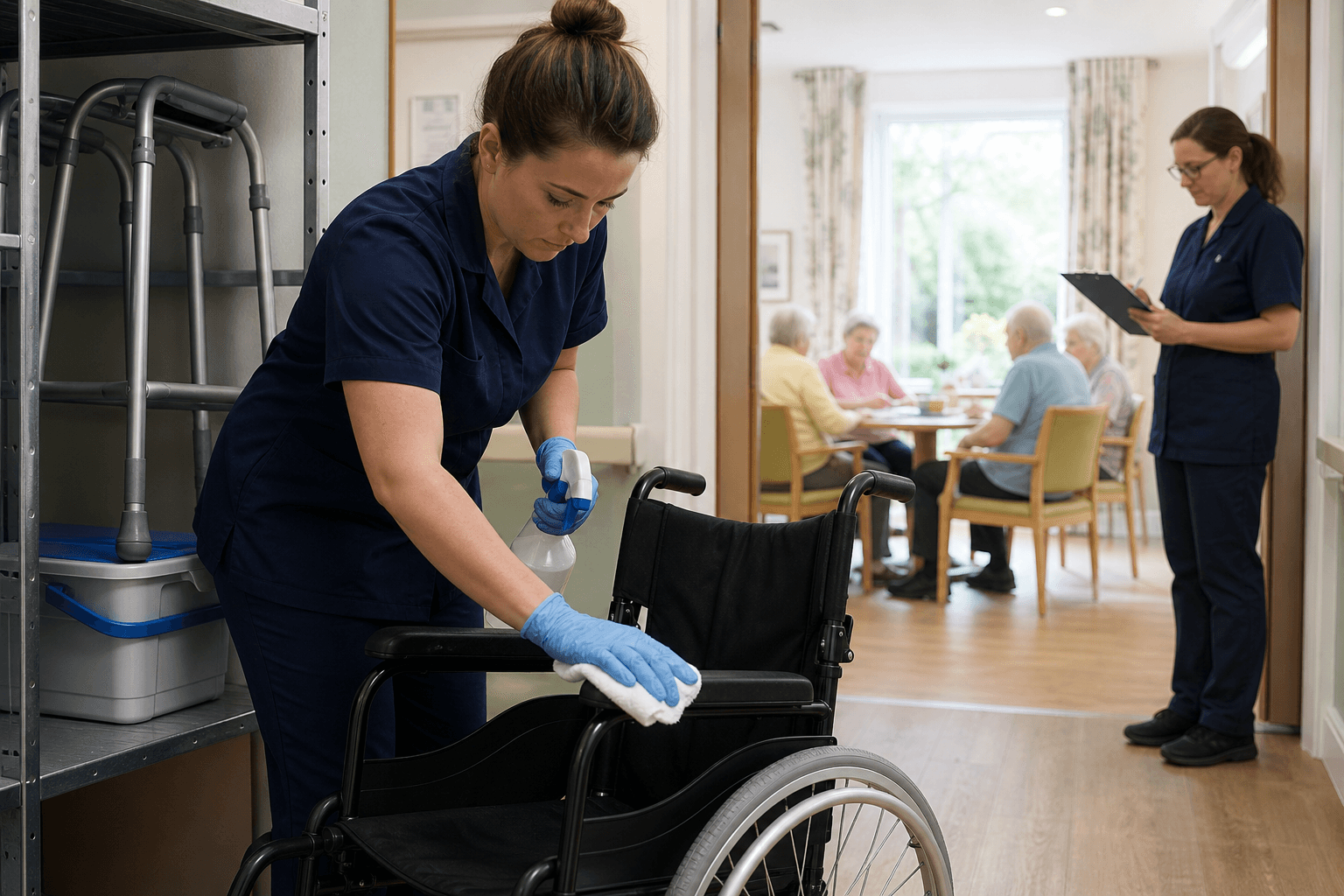
A clean wheelchair, walking frame, commode or other shared item is part of safe care. It should not be an optional job left until there is time.
UKHSA advises that shared equipment should be disinfected before and after use. In residential and day-care settings, teams should also:
- keep clean and dirty equipment separate
- ensure cleaning materials are accessible where equipment is used or stored
- avoid storing clean equipment in dirty utility areas
A practical equipment-cleaning workflow
A simple local workflow can make responsibilities visible:
- Identify the item as shared and know the local cleaning product and process for it.
- Clean or disinfect it before use where required by the local process.
- Clean or disinfect it after use, rather than leaving it for the next colleague.
- Return it only to the clean storage area once the process is complete.
- Clean hands after the task, including after glove removal.
For communal settings, UKHSA recommends daily cleaning using effective detergents and disinfectants, with more frequent cleaning of high-touch points. These include door handles, bed rails, light switches, appliance handles, phones and computer keyboards.
Domiciliary care: protect each home and the journey between visits
Equipment taken between homes needs particular attention. UKHSA advises that it is thoroughly cleaned between visits.
After an item has been used in a person’s home, clean it immediately. Clean it again before placing it in the vehicle, and again before storage. A clean, dry, lidded box can be used for transport or storage.
This is a useful moment for providers to check whether the practical arrangements match the policy. For example, staff need access to suitable cleaning materials and a clear place to keep cleaned equipment separate from items awaiting cleaning.
UKHSA also advises that placing a known or suspected MDRO case at the end of a domiciliary care run is unnecessary when IPC is followed correctly. Delaying essential care can cause harm. A person’s care plan should not change solely because they carry an MDRO.
Dignity and inclusion are part of safe IPC
IPC should reduce avoidable transmission without unnecessarily reducing a person’s independence, social contact or control over daily life.
UKHSA is clear that IPC measures should be balanced with dignity, autonomy and inclusion. A person carrying an MDRO can take part in communal social and rehabilitation activities and use shared spaces when IPC principles are followed. Where relevant, wounds should be covered with appropriate dressings.
Known MDRO carriage alone should not lead to:
- refusal of admission or readmission
- restrictions on visitors
- restrictions on leaving the care setting
- automatic exclusion from communal activities
- delayed essential domiciliary care
Additional measures may sometimes be needed, but they should be based on an individual risk assessment and local IPC advice—not assumptions about the person.
Communicate without stigma
The way staff explain MDROs can either build trust or create anxiety. Use calm, plain language. Explain that a person may carry an organism without being ill, describe the practical measures being used, and make space for questions.
Support people and visitors to clean their hands, particularly before eating or taking medicines and after using the toilet, a pan or commode, coughing, or using tissues. Families should be reassured that people can generally continue normal family contact, including with infants and young children; the relevant healthcare professional can advise where a family member may be especially vulnerable.
Care plans, transfers and confidentiality
Suspected or confirmed MDRO carriage or infection should be recorded in the individual care plan, along with detailed IPC advice. This supports consistent care across shifts and helps prevent vital information being lost during a transfer.
Use usual local communication channels to share infection status with relevant adult social care and healthcare providers when a person transfers. The purpose is safe ongoing care—not wider disclosure.
Health information is confidential. Information should be available to staff directly involved in the person’s care, who need it to provide that care safely. The Information Commissioner’s Office notes that care providers must ensure staff understand their confidentiality responsibilities when handling health and social care information.
Avoid discussing a person’s MDRO status where other residents, visitors or staff without a care role can hear. Record clear, relevant instructions, but do not use stigmatising language.
What managers should check
Reliable IPC is a leadership and systems issue as well as an individual practice issue. UKHSA advises managers to have systems that regularly check whether hand hygiene and environmental and equipment cleaning are being followed, then use findings to identify training and support needs.
A focused review can ask:
- Are soap, hand rub and cleaning products accessible at the point of use?
- Do staff know when soap and water is required instead of hand rub?
- Is shared equipment visibly separated into clean and dirty areas?
- Is equipment cleaning built into shift routines and domiciliary travel arrangements?
- Do care plans contain relevant, practical IPC advice?
- Are transfer communications confidential and consistent with local procedures?
- Are audits used constructively to improve practice and training?
This aligns with the Care Quality Commission’s adult social care key lines of enquiry, which include infection control within safe care, privacy and dignity within caring, person-centred care within responsiveness, and governance and management within well-led services.
Quick checklist for care teams
Before finishing a care task or moving shared equipment on, pause and check:
- Have I cleaned my hands at the right points, including after removing gloves?
- Do I need soap and water because hands are soiled, body fluids may be present, or there is vomiting or diarrhoea?
- Has the shared item been disinfected before and after use in line with local procedure?
- Is clean equipment separate from dirty equipment?
- Have I maintained the person’s dignity, inclusion and confidentiality?
- Is any relevant IPC information accurately recorded and communicated only to those involved in care?
Frequently asked questions
Can someone carry an MDRO without being ill?
Yes. A person may carry an MDRO without symptoms. UKHSA states that carriage can last for years and is not harmful in itself, although some people are at greater risk of developing an infection.
Should a resident with an MDRO stay away from communal activities?
Not solely because of MDRO carriage. UKHSA says people can participate in communal social and rehabilitation activities and use shared spaces when IPC principles are followed. Decisions about any additional measures should be based on risk assessment and local IPC advice.
Do gloves remove the need for hand hygiene?
No. NICE states that effective hand decontamination includes cleaning hands after gloves have been worn. Gloves do not replace hand hygiene.
Should domiciliary carers visit a person with known MDRO carriage last?
Not automatically. UKHSA advises that this is unnecessary where IPC is correctly followed and may delay essential care. A care plan should not change solely because a person carries an MDRO.
Who should be told about a person’s MDRO status?
Record relevant status and IPC advice in the care plan, and share information through usual local channels when needed for safe care during transfers. Maintain confidentiality and limit access to staff directly involved in providing care.
Conclusion
Managing MDROs in adult social care comes back to dependable basics: clean hands, clean equipment, clean surroundings and clear communication. These measures work best when they are embedded in daily routines and delivered with respect.
A person’s MDRO status should inform safe care, not define what they can do, who can visit them or whether they receive timely support. Review local IPC procedures with your team, use audit findings to guide learning, and seek local IPC advice when an individual risk assessment raises questions.
Clarivive MedInsight supports healthcare and social care teams to turn evidence-based knowledge into confident everyday practice. Use this topic as a discussion point in supervision, handover or IPC training, and consider where your current routines make the safe action the easy action.
References
- UK Health Security Agency (UKHSA): Infection prevention and control for multidrug-resistant organisms in adult social care settings
- Care Quality Commission (CQC): Key lines of enquiry for adult social care services
- National Institute for Health and Care Excellence (NICE): Quality statement 3 – Hand decontamination
- Information Commissioner’s Office (ICO): Conditions for processing special category data